


Cable Assembly vs Wire Harness: How to Choose the Right One


Every electronic system depends on reliable connections to function properly. From industrial machinery and automotive systems to everyday electronic devices, wires and cables carry the power and signals that keep everything running. However, the way these connections are arranged, protected, and installed can affect a product's performance, durability, and overall cost.
This is where the discussion around cable assembly vs wire harness becomes relevant. Although both connect electrical components, they differ in construction, protection, flexibility, and application. A cable assembly typically provides a defined electrical connection with application-specific protection, while a wire harness organizes multiple wires for efficient routing and installation.
Understanding the difference between cable assembly and wire harness helps OEMs avoid unnecessary expenses, prevent design complications, and make informed manufacturing decisions.
Key Takeaways
The main difference between cable assembly and wire harness lies in their construction, protection, and wiring arrangement.
Cable assemblies support reliable electrical connections, while wire harnesses organize multiple wires for easier routing.
The advantages of cable assembly include application-specific protection, shielding, and dependable signal transmission.
The benefits of wire harness solutions include organized wiring, flexible routing, and simpler installation.
Material specifications, design complexity, and production volume influence cable assembly cost and wire harness pricing.
The right solution depends on your product's electrical requirements, operating environment, and budget.
Table of Contents
What Is a Wire Harness?

The wire harness refers to a group of electrical wires arranged and secured together to connect different components within a system.
These wires are typically bundled using tapes, cable ties, sleeves, or conduits to keep connections organized and prevent tangling.
Wire harnesses are commonly designed for applications involving multiple connection points. Their branching structure allows wires to reach different parts of equipment without creating unnecessary clutter. Common types of wire harnesses include automotive harnesses, industrial control harnesses, power distribution harnesses, and appliance wiring harnesses.
What Is a Cable Assembly?
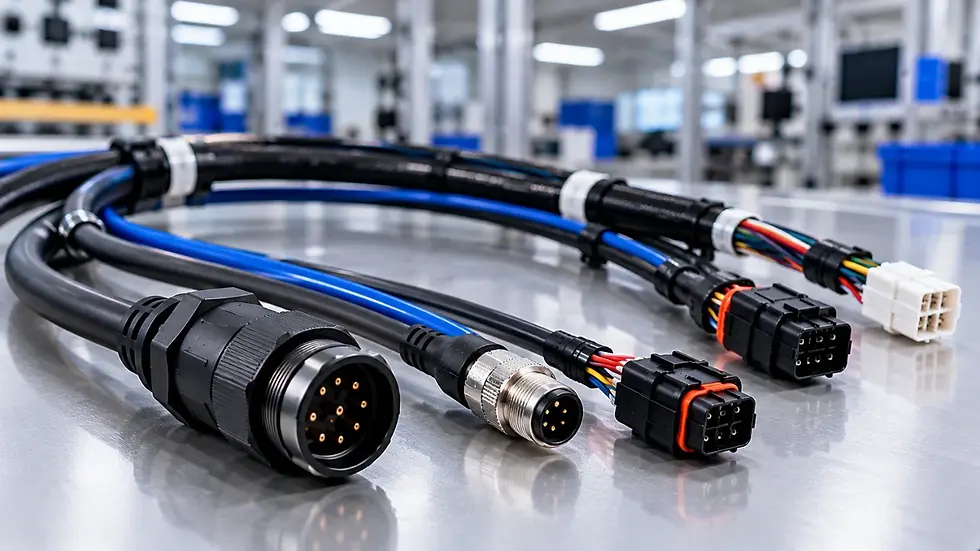
Cable assembly meaning refers to a finished electrical connection made from one or more cables fitted with connectors, terminals, and application-specific protective materials.
Cable assemblies may include outer jackets, shielding, strain relief, or environmental seals to protect electrical connections during operation. Common types of cable assemblies include power cables, coaxial cables, data cables, and multi-conductor cable assemblies.
One of the important benefits of cable assembly solutions is their ability to support reliable power or signal transmission under specific operating conditions.
For example, shielded cable assemblies can help protect sensitive signals from electromagnetic interference in industrial equipment.
Cable Assembly vs Wire Harness: Detailed Comparison
The primary difference between cable assembly and wire harness becomes clearer when comparing their construction, protection, and intended applications.
Feature | Cable Assembly | Wire Harness |
Construction | One or more cables fitted with connectors | Multiple wires grouped into an organized arrangement |
Protection | May include jackets, shielding, and sealing | Typically uses tape, sleeves, or protective conduits |
Routing | Often suited to defined connection paths | Suitable for multiple branches and connection points |
Flexibility | Depends on cable materials and construction | Can accommodate complex wiring layouts |
Cost | Influenced by cable type, connectors, and protection | Influenced by wire count, branching, and assembly labor |
Applications | Communication systems, sensors, industrial equipment | Automobiles, appliances, control panels, machinery |
Both solutions can be customized to meet electrical, mechanical, and environmental requirements.
Advantages and Limitations of Each
Each wiring solution offers practical benefits, but its suitability depends on the application.
Advantages of Cable Assembly
The main advantages of cable assembly solutions include:
Better Protection: Suitable jackets, shielding, and seals help protect connections from moisture, abrasion, and electrical interference.
Reliable Signal Transmission: Properly designed cables support consistent electrical performance.
Custom Configurations: Cable lengths, connector types, and protective materials can be adapted to specific applications.
However, specialized connectors, shielding, and protective materials can increase manufacturing expenses.
Advantages of Wire Harness
The main advantages of wire harness solutions include:
Organized Connections: Multiple wires remain grouped, making installation and troubleshooting easier.
Flexible Routing: Branching arrangements allow connections to reach different components.
Simplified Installation: Preassembled wiring layouts can reduce installation time and wiring errors.
These benefits of wire harness solutions make them useful for equipment containing several electrical connection points.
However, harnesses with limited protective coverings may need additional protection in demanding environments.
You May Also Read: How to Choose the Right Custom Cable Assembly Manufacturer: A Guide for OEMs
Where Each One Is Used
The application often determines which wiring arrangement makes the most sense.
Cable assemblies are frequently used in industrial automation equipment, communication devices, medical electronics, and sensor systems.
For instance, an industrial sensor exposed to repeated movement may require a flexible cable assembly with suitable strain relief and abrasion protection.
Wire harnesses are widely used in automotive electronics, household appliances, industrial control panels, and manufacturing machinery.
A vehicle dashboard provides a familiar example. Its wiring harness connects switches, displays, sensors, and electronic control units through an organized network.
Some products use both solutions. Industrial equipment may use wire harnesses for internal wiring and cable assemblies to connect external devices.
How to Choose the Right Solution for Your Build

The cable assembly vs wire harness decision should begin with your product's technical requirements.
A few practical questions can help narrow down the options:
Operating Conditions: Will the wiring face moisture, vibration, high temperatures, chemicals, or repeated movement?
Electrical Requirements: What voltage, current, insulation, and shielding specifications does the system require?
Connection Layout: Does the equipment need several branching connections or a direct connection between components?
Available Space: How much room is available for routing, bending, and securing the wiring?
Production Requirements: What are the expected manufacturing quantities, testing needs, and budget limits?
An experienced cable assembly manufacturer can review these requirements and recommend suitable construction methods. For complex applications, a custom cable assembly manufacturer can also help assess connector compatibility, material specifications, and manufacturing feasibility.
Common Misconceptions That Lead to Bad Purchases
One common mistake is assuming that cable assemblies are always more durable than wire harnesses. In practice, durability depends on insulation, protective coverings, connector quality, and operating conditions. A properly protected wire harness can perform reliably in demanding applications.
Another misconception is that wire harnesses always cost less. A complicated harness containing multiple branches, connectors, and termination points may require considerable manual labor, increasing its manufacturing cost.
OEMs sometimes treat both products as interchangeable without reviewing their electrical and mechanical specifications. This can lead to installation difficulties, unnecessary design changes, and additional production expenses.
Cost Differences: What Drives the Price of Each
The cable assembly cost depends on several factors, including conductor materials, cable length, shielding, connector specifications, and production quantity.
For example, a cable assembly requiring specialized insulation and sealed connectors will generally involve different manufacturing expenses than a basic power cable.
Wire harness pricing is influenced by the number of wires, branching complexity, terminal types, routing requirements, and assembly operations. A harness connecting several components may require additional cutting, stripping, crimping, labeling, and inspection.
Production volume also matters. Larger manufacturing batches can spread setup expenses across more units, while smaller custom orders may carry higher per-unit costs. Instead of comparing prices alone, OEMs should consider installation effort, maintenance requirements, and expected service life.
Final Thoughts
The right wiring solution depends on how your product needs to distribute electrical power, transmit signals, and protect its connections. Cable assemblies are well suited to applications requiring specific cable construction, shielding, or environmental protection. Wire harnesses offer an organized way to connect multiple components across a system.
Understanding the cable assembly vs .wire harness comparison helps OEMs make practical decisions based on performance, installation requirements, and manufacturing costs.
At A2Z Electronics, we support OEMs with custom cable assembly and wire harness manufacturing solutions designed around their project requirements. Contact A2Z Electronics to discuss your application and explore a wiring solution that meets your technical needs and production budget.
FAQs
Is a wire harness the same as a cable assembly?
No, a wire harness and a cable assembly are not exactly the same. A wire harness organizes multiple wires for easier routing and installation, while a cable assembly typically combines cables, connectors, and protective materials for specific electrical connections.
Which is more expensive, a cable assembly or a wire harness?
The cost depends on design complexity, materials, and production requirements. Cable assemblies with specialized shielding or connectors may cost more, while complex wire harnesses with multiple branches and connections can also be expensive.
Can a cable assembly be part of a wire harness?
Yes, a cable assembly can be integrated into a larger wire harness. This arrangement allows manufacturers to combine organized wiring with specific cable connections to meet the electrical and mechanical requirements of a product.
What is the difference between a wire harness and a cable assembly?
The main difference between cable assembly and wire harness is their construction and purpose. Wire harnesses group and route multiple wires, while cable assemblies provide defined electrical connections with protection suited to their applications.
Which one is better for harsh environments?
Cable assemblies are often preferred for harsh environments because they can include protective jackets, shielding, and sealed connectors. However, a properly designed wire harness with suitable insulation and protective coverings can also withstand demanding operating conditions.


